
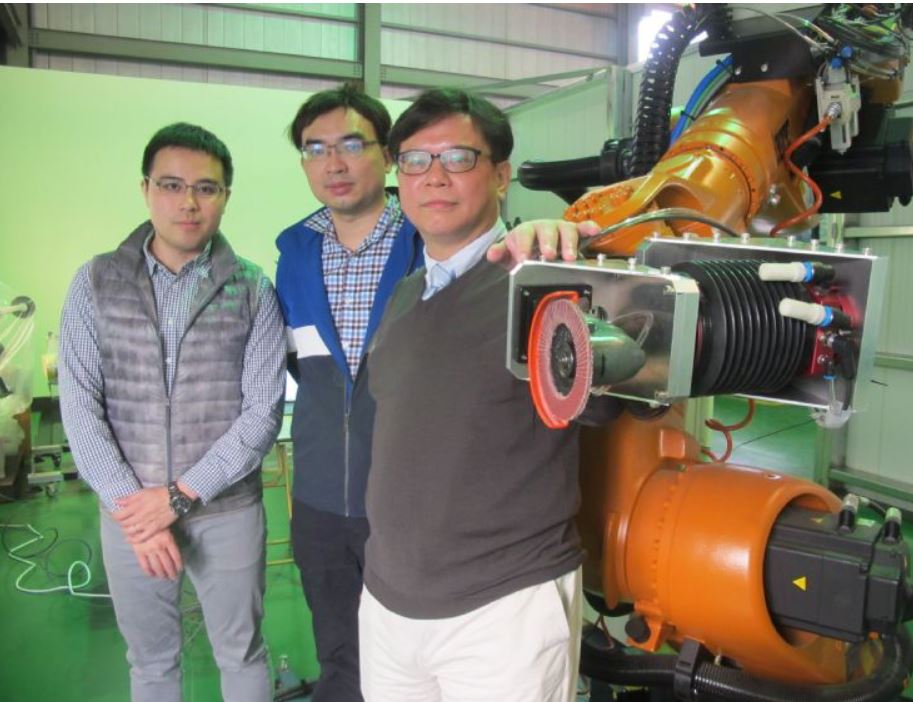
The highlight of Robuff is not only the perception of force, but more importantly, the ability to control force feedback, and this process is two-way. Usually the robot arm needs to use a force/torque sensor when detecting force, which compensates the posture and force of the robot arm during processing through real-time signal feedback. However, Robuff CEO Peng-Chih Chen said that when the general force sensor detects the end reflection force, it usually controls the robot arm. The force control feedback device of Robuff uses a pneumatic linear actuator installed at the end of the arm to perform actions with a preset force. This will highlight the difference in some processes that particularly rely on precise displacement control and at the same time require force control of the contact surface.
The pneumatic linear actuator looks like a spring. "You can think of it as a human muscle!" Peng-Chih Chen said. Human muscles can stretch and contract freely. Using the same concept, through four sensors loaded on the spring, including force, accelerometer, displacement, gyroscope, etc., the force can be controlled in multiple degrees of freedom. When the force on the contact surface is found to be too large or too small, after parameter calculation and adjustment, the spring will automatically adjust to achieve more subtle contraction or expansion. Among them, accelerometers and gyroscopes can improve uneven or unstable force application due to changes in gravity angle.
Related links:
https://www.digitimes.com.tw/iot/article.asp?cat=158&cat1=20&cat2=10&cat3=11&id=0000604091_HZYL0IWALWE00V095M9WB